Affichage des articles dont le libellé est smartphone. Afficher tous les articles

mercredi 13 juillet 2016

samsung galaxy note 5

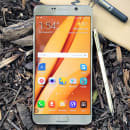
Samsung's Galaxy Note series has never been for everyone, but the Note 5 just might change some minds. It's the smallest, most comfortable version of the phablet to date, and thoughtful software tweaks make the S Pen feel way less gimmicky. A great screen and first-rate performance are icing on the proverbial cake, but some people will still feel burned by the lack of expandable memory, a bigger 128GB option or a removable battery.
Pros
  • Amazing screen
  • Top-tier performance
  • Much-improved S Pen experience
  • Greatcamera
Cons
  • Grabbing the S Pen takes an extra step
  • Some will miss the microSD slot
  • Far pricier than similar phones
Samsung Galaxy Note 5 review: the best big phone just got better
For a while there, companies like Palm and Microsoftinsisted that the mark of a serious smartphone was the ability to write on it with a stylus. The industry seemingly changed its mind with the advent of capacitive touchscreens, and the stylus became something to scoff at, a holdover from antiquated operating systems like Windows Mobile and Palm OS. But then there's Samsung, which has been trying for years now to keep the idea alive with several versions of the Galaxy Note, a phablet that never quite felt or looked as nice as it should. Well, those days are over. The new Note 5 is the best big phone Samsung has made yet, and it just might make a believer out of a few naysayers.

samsung galaxy core2

NETWORKTechnologyGSM / HSPA
LAUNCHAnnounced2014, June
StatusAvailable. Released 2014, July
BODYDimensions130.3 x 68 x 9.8 mm (5.13 x 2.68 x 0.39 in)
Weight138 g (4.87 oz)
SIMDual SIM (Micro-SIM, dual stand-by)
DISPLAYTypeTFT capacitive touchscreen, 256K colors
Size4.5 inches (~65.1% screen-to-body ratio)
Resolution480 x 800 pixels (~207 ppi pixel density)
MultitouchYes
PLATFORMOSAndroid OS, v4.4.2 (KitKat)
CPUQuad-core 1.2 GHz
MEMORYCard slotmicroSD, up to 64 GB (dedicated slot)
Internal4 GB, 768 MB RAM
CAMERAPrimary5 MP, autofocus, LED flash
FeaturesGeo-tagging, touch focus, face/smile detection
Video480p@30fps
SecondaryVGA
SOUNDAlert typesVibration; MP3, WAV ringtones
LoudspeakerYes
3.5mm jackYes
COMMSWLANWi-Fi 802.11 b/g/n, Wi-Fi Direct, hotspot
Bluetoothv4.0, A2DP
GPSYes, with A-GPS, GLONASS
RadioFM radio
USBmicroUSB v2.0
FEATURESSensorsAccelerometer
MessagingSMS(threaded view), MMS, Email, Push Mail, IM
BrowserHTML
JavaNo
- MP4/WMV/H.264 player
- MP3/WAV/eAAC+/FLAC player
- Photo/video editor
- Document viewer
BATTERYRemovable Li-Ion 2000 mAh battery
Talk timeUp to 7 h (3G)
Music playUp to 30 h
MISCColorsWhite, Black
SAR EU0.42 W/kg (head)     0.45 W/kg (body)    
Price group3/10

iphone 4s

KEY FEATURES

  • 3.5in Retina (960 x 640) LCD display
  • 8 megapixel camera with 1080p video
  • Dual core A5 processor
  • Dual antennae for better signal
  • Same chassis design as iPhone 4
  • Manufacturer: Apple
  • Review Price: free/subscription
The iPhone 4S was never supposed to be. At least not in the eyes of the public, the tech industry and journalists alike. The iPhone 4 had already been out for 17months – a lifetime in the mobile phone sector – reports of iPhone 5 cases and concept designs had been floating around for a while, and surely it was time for Apple to change the stylistic record? Not so. Instead we have an iPhone 4 with everything turned up to 11, or at least 9 anyway.
Check out our video review of the iPhone 4S:
0:00
/
4:12
 
Contrary to initial reactions from many, though, this shouldn't be cause for lamentation as where it counts the iPhone 4S is up there with the best. However, the list of meaningful hardware differences is rather short. There's a new CPU in the form of the same dual-core A5 CPU as used on the iPad 2 (though it's clocked at 800MHz rather than 1GHz), meanwhile the iPhone 4 has a single core chip running at 1GHz. The A5 chip also packs in seven times the graphics performance of the iPhone 4, according to Apple.
Also new is an 8-megapixel camera with 1080p video recording, a redesigned antennae and the new Siri voice controlled assistant. All of which we'll be looking at in detail throughout this review.
Apple iPhone 4S 9
But back to that design. The iPhone 4S is almost identical in appearance to the iPhone 4. The only visible difference comes courtesy that new antennae design. On both phones the antennae is incorporated into the stainless band that wraps round the edge, and famously on the iPhone 4 this lead to problems when the phone was held such that your hand or fingers covered the thin strips of black plastic that seperated the aerial into segments.
On the iPhone 4S these black strips have doubled in number, indicating the phone's use of two antennae. Thanks to having to incorporate these extra black strips, the mute switch on the left edge has had to move closer to the volume buttons.
This slight change in button placement could actually be one of this phone's first major problems as many iPhone 4 cases that otherwise would've fit may not do so now. If you've invested in a decent case, that it is incompatible may be enough to put you off until the iPhone 5 arrives.
Apple iPhone 4S 4
Otherwise it's same old, same old.
The front and back are formed of two slabs of toughened glass that are incredibly resistant to everyday scratches though prone to shattering if dropped. That said, in the 17months we've been using an iPhone 4 it has taken three pocket height drops (two onto tarmac and one particularly unfortunate one right onto a thick metal strip than run along a doorway) and it has only a couple of scratches to the metal band and a nick in the thin plastic strip that sits between the metal and glass.
While the toughness debate will no doubt rage on, what can't be denied is how horrendously slippery the glass surface is. It may sound like an odd complaint but whether you're wearing gloves or resting the phone on the arm of a sofa, it has an incredible ability to slide on fabric. We appreciate the logic of this minimalist design but do hope a more practical finish graces the iPhone 5.
Apple iPhone 4S
Set into the front pane of glass is the phone's single Home button, which now serves a number of purposes we'll cover throughout the review. Also on the front is the front-facing camera, which hasn't increased in resolution from the miserly 640 x 480 pixels of the iPhone 4 - it's just about enough for face to face video chat.
The back is home to the all important new camera (the increased lens size of which is just about discernible) with its accompanying LED. Adding a second LED, or even a Xenon flash, would've been a nice move but it's certainly not typical to find two in use.
Apple iPhone 4S 2
As for those industrial steel edges, the right is feature free apart from the microSIM slot - despite reports suggesting these would become standard they still some to be the exception rather than the rule - while the left houses the mute switch and two volume buttons, the top one of which doubles as the shutter button for the camera. We still prefer the more pronounced volume rocker of the iPhone 3G/3GS as it was easier to locate by touch alone through a case or the fabric of a pocket. And while we're on the subject, we're reminded how much more comfortable to hold those handsets were.
The bottom is home to the standard Apple charging and syncing dock and it's flanked by the microphone and speaker, the latter of which remains one of the better ones available. Up top, meanwhile, is the headphone socket, noise cancelling microphone and power button/lock button. As ever, there's no HDMI socket, no easily accessible battery and no microSD slot for expanding the memory, though with 64GB handsets available the latter point is less of a concern than ever.
Read more at http://www.trustedreviews.com/apple-iphone-4s-review#dPeYDGA4Aq4HQDi3.99

iphone 4

Awards
  • image: http://www.trustedreviews.com/images/awards/tr-recommended.png
    Recommended by TR

SUMMARY

OUR SCORE:

USER SCORE:

PROS

  • Attractive design
  • High resolution display
  • iOS is intuitive and powerful

CONS

  • Very expensive
  • Battery life suffers under heavy use
  • Concerns over antennae and glass

KEY FEATURES

  • Retina Display
  • iOS 4
  • App Store
  • 5MP camera with autofocus and flash
  • Manufacturer: Apple
  • Review Price: free/subscription
Introduction
So, another year, another iPhone. The latest version of Apple's iconic touchscreen smartphone is now available and it brings with it a whole host of new and innovative features. Is it worthy successor to its forebears the iPhone, iPhone 3G, and iPhone 3GS and, more to the point, is it worth its high asking price or should you hold out for the next round of Android, Windows 7, Meego, or WebOS devices? Read on to find out.
iPhone 4 - Video Review
0:00
/
0:00
 
iPhone 4 - Design
Most striking about the iPhone 4 is its new design. While the front is classic iPhone with its single piece of glass, single button, and symmetrical black bezel, the back has moved away from the curves of old to be replaced by a completely flat sheet of aluminosilicate-toughened glass (what do you mean you haven't heard of it?!). Combined with the new flat stainless steel sides, this gives the phone a particularly industrial, minimalist look and feel that is sure to split opinion even more than existing iPhones have.
To our minds the concept is sound and we really like the exceptional fit and finish of the phone but certainly the front bezel does now look a bit tired. In particular this seems to be because the iPhone 4 is slightly narrower and taller, yet retains the same size screen, as previous models. This makes the screen look a bit lost in the vast blackness of that bezel. It's still a pretty stunning design overall but there's definitely a prototype/engineering sample feel that takes the edge off.
iPhone 4 back
By severely shrinking many of the internal components, Apple has managed to make the iPhone 4 noticeably slimmer than its forebears at just 9.3mm, and the company even touts it as the slimmest smartphone on the market. Normally we would be concerned about this as the slimmer devices get, the more difficult they tend to be to handle but thanks to its flat sides the iPhone 4 is actually pretty easy to get a good grip on. However, the pointy edges that result from all those flat surfaces make the phone feel, if not out and out uncomfortable, certainly less comfy than many rivals and even previous iPhones. Weight remains largely unchanged at 137g, 2g more than the iPhone 3GS.
iPhone 4 side
Another potential pitfall of having so much glass is its propensity to crack or shatter when knocked. However, while having glass on the front and back does double your chances of this happening, it only really matters if the screen breaks, and there's just as much change of that happening on any other smartphone.
Moreover, in our experience, unlike plastic, glass screens are essentially scratch proof in normal use so using glass on the back as well will hopefully mean the iPhone 4 will look flawless for years to come, no matter how rough you treat it. Certainly we know many people that have not been overly careful yet own three year old iPhones that don't have a single scratch on the screen, which is more than can be said of the aluminium and plastic backs of said phones.
One insurmountable downside of the glass design, though, is its slipperyness. It is quite remarkable how the phone will slide off almost any surface you place it on, unless it's perfectly flat - say goodbye to resting your phone on the arm of a sofa or on your lap, unless you buy a case of course.

Read more at http://www.trustedreviews.com/iphone-4-review#AlWLqbvbBvYjbsXc.99